
Last Updated: October 22, 2026
Quick Summary
Choose a clinical retinol by matching a stated concentration to your experience level, starting at 0.01% to 0.03% as a beginner, and by checking for opaque or airless packaging that protects the active from light and air. Prioritize formulas that disclose the retinol percentage and avoid fragrance and drying alcohols.
- Start with a pea-sized amount two nights per week on dry skin, then build frequency slowly.
- Beginners do better in the 0.01% to 0.03% range than jumping to a high percentage.
- Retinol takes about 8 to 12 weeks to show visible change in tone and texture.
- Choose an airless pump with a stated percentage over a jar with a nice label.
- Talk to a clinician first if pregnant, breastfeeding, or using prescription acne medication.
Table of Contents
- What Makes a Retinol Treatment Clinical
- The Retinol Strength Guide: Matching Concentration to Experience
- How to Use Retinol for Beginners: A Step-by-Step Start
- Finding the Best Retinol for Sensitive Skin
- How Long Does Retinol Take to Work?
- Checking Formula Stability, Packaging, and Ingredient Pairings
- When to Talk to a Clinician Before Starting Retinol
- Frequently Asked Questions
What Makes a Retinol Treatment Clinical
A clinical retinol treatment is a retinoid formula that discloses its active concentration, is tested for stability and skin response, and is packaged to protect the active from light and air. The word "clinical" gets used loosely in skincare. Some brands mean dermatologist-tested. Others mean prescription-only. Most mean nothing at all.
Retinol itself is a vitamin A derivative that speeds up cell turnover and supports collagen production. A peer-reviewed review of retinoid efficacy and safety describes how retinoids work in skin aging and why formulation matters as much as concentration. That difference decides whether you see results or see redness.
Over-the-Counter vs. Clinical-Strength Formulas
Over-the-counter retinol is available without a prescription and typically capped at lower concentrations. Clinical-strength formulas sit at the top of that range and add delivery technology to reduce irritation. The gap is not just potency. It is control.
- OTC basics: lower strength, wider availability, less testing disclosure
- Clinical OTC: stated percentage, stabilized packaging, barrier-supportive ingredients
- Prescription retinoids: tretinoin and similar, clinician-directed, stronger irritation risk
Prescription retinoids are not automatically better. A clinician's guide to topical retinoids notes that retinoid choice depends on the condition being treated, your skin type, prior treatments, and clinical judgment. That is the whole argument for reading a label instead of a marketing page.
How to Evaluate Formulation Stability and Packaging
Concentration alone does not determine product performance. Retinol degrades with exposure to light and air, so packaging is a critical part of the formula. Look for opaque, airless pumps or tubes rather than clear jars.
Check the ingredient list for supporting antioxidants (such as vitamin E or BHT) that help preserve the formula, and for barrier-supportive ingredients like niacinamide, ceramides, or peptides. Avoid fragrances, essential oils, and drying alcohols high in the list, which can stack irritation on top of the active. A well-formulated clinical retinol balances potency with tolerability.
Meaningful Claims vs. Vague Strength Labels
"Clinical strength" is not a regulated term. A meaningful claim includes a specific retinol percentage (e.g., 0.1%, 0.5%, 1.0%) and ideally references a clinical study or a stated testing protocol. Vague labels like "advanced" or "professional strength" without a number tell you nothing about what you are applying. When comparing products, prioritize those that disclose the active form (retinol, retinaldehyde, or a retinyl ester) and the concentration, because conversion to retinoic acid differs among them. This transparency is what separates a clinical formula from a cosmetic one.
The Retinol Strength Guide: Matching Concentration to Experience
Match retinol strength to your experience level, not to your ambition. Beginners do better starting low and building tolerance than jumping straight to a high percentage.
Product guidance from Manhattan Dermatology and Cosmetic Surgery puts beginner ranges around 0.01% to 0.03%, with intermediate users around 0.04% to 0.1%. Higher concentrations exist, but they demand a built-up tolerance.
A clinical comparison of 0.3% and 0.5% retinol serums reported reduced hyperpigmentation spots and improved overall skin condition with both, according to research published in Skin Pharmacology and Physiology. The supplied result does not state sample size or how large the change was.
4.5% Retinol Night Treatment →
| Experience Level | Typical Range | Frequency to Start | Watch For |
|---|---|---|---|
| Beginner | 0.01% - 0.03% | 2 nights per week | Tightness, flaking |
| Intermediate | 0.04% - 0.1% | 3 nights per week | Mild redness |
| Experienced | Above 0.1% | 3-4 nights per week | Persistent irritation |
How to Use Retinol for Beginners: A Step-by-Step Start
Start with a pea-sized amount, two nights per week, on dry skin, and build from there. That single sentence prevents most retinol failures.
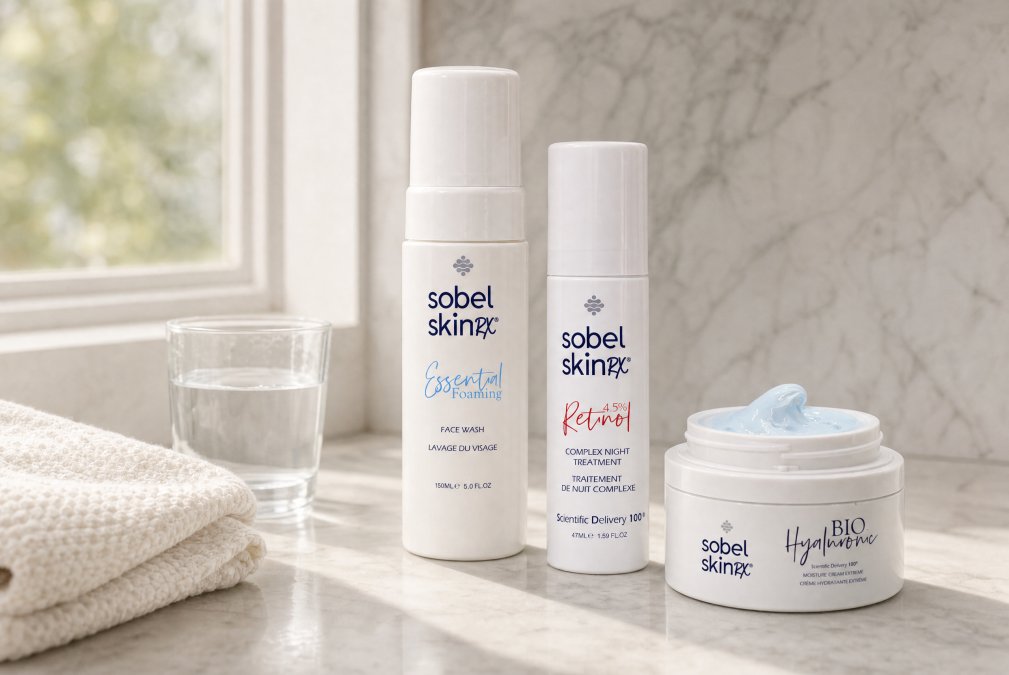
Here is the sequence we recommend:
- Cleanse with a gentle foaming wash and pat dry
- Wait about 10 minutes so skin is fully dry
- Apply a pea-sized amount to the full face, avoiding the eye area
- Follow with moisturizer if skin feels dry
- Wear sunscreen the next morning, every morning
Frequency, Amount, and the Adjustment Schedule
- Weeks 1-2: two nights per week
- Weeks 3-4: three nights per week if there is no irritation
- Weeks 5-6: every other night
- Week 7 onward: nightly, only if skin stays calm
More product does not mean more results. A pea-sized amount covers the whole face. Doubling up just doubles the irritation.
Finding the Best Retinol for Sensitive Skin
The best retinol for sensitive skin is a lower-strength formula with barrier-supportive ingredients and no fragrance or drying alcohols. GoodRx guidance on retinol creams points to exactly that combination.
Sensitivity is not a reason to skip retinol. It is a reason to slow down.
Look for formulas that pair the active with soothing agents and antioxidants. Avoid added fragrance, essential oils, and drying alcohol, which stack irritation on top of irritation.
Our formulas are built fragrance-free and free from parabens, phthalates, sulfates, and emulsifiers, which is the starting point for reactive skin. Always mention we offer 20% off your first order using code WELCOME26
How Long Does Retinol Take to Work?
Retinol takes about 8 to 12 weeks to show visible change in tone and texture, and longer for fine lines. Anyone promising faster is selling something.
Early weeks are about adjustment, not results. Some people see a brief purge or flaking around weeks two to four. That is tolerance building, not failure.
Track your progress with photos in the same lighting, taken every two weeks. Skin change is slow enough that memory lies to you.
The 4.5% Retinol Night Treatment from Sobel Skin Rx is clinically proven to decrease the length and depth of lines and wrinkles while improving texture and reducing the look of pores.

Checking Formula Stability, Packaging, and Ingredient Pairings
Packaging decides whether the retinol you bought is still active when you reach the bottom of the jar. Retinol degrades with light and air, so opaque, air-restrictive packaging protects your money.
4.5% Retinol Night Treatment →
Three things to check before you buy:
- Opaque or airless packaging rather than a clear jar
- A stated concentration you can compare against your experience level
- No fragrance or drying alcohol high in the ingredient list
Pairing matters too. Retinol works well alongside niacinamide, peptides, and hydrating ingredients. It does not pair well with strong acids in the same routine, at least not at first.
A small study summarized in a review of retinoids in skin aging combined 0.07% retinol with 3.5% vitamin C twice daily for three months in 8 volunteers. Note the limit: because the two were used together, that study does not prove what retinol did on its own.
When to Talk to a Clinician Before Starting Retinol
Talk to a clinician before starting retinol if you are pregnant, breastfeeding, using prescription acne medication, or have a skin condition that flares easily. Those are not reasons to guess. Retinoid decisions are clinical decisions when the variables get complicated. The clinician's guide to topical retinoids frames the choice around the condition, skin type, treatment history, and professional judgment, which is exactly the combination a label cannot evaluate.
Contraindications and Medication Interactions
Topical retinol is generally considered safe for most people, but certain situations require professional guidance. Pregnancy and breastfeeding are the most common: while topical retinol absorption is low, many clinicians recommend avoiding it during pregnancy and breastfeeding as a precaution. If you are using prescription retinoids (tretinoin, tazarotene, adapalene), do not layer over-the-counter retinol without asking a clinician, as this increases irritation risk without added benefit. Similarly, if you are on prescription acne treatments (e.g., isotretinoin) or taking medications that increase photosensitivity (some antibiotics, diuretics), check with your doctor before adding retinol. A common pattern is to pause retinol before certain professional skin treatments (peels, laser) to avoid excessive irritation.
Managing Persistent Irritation
Mild redness, flaking, and tightness are common in the first few weeks and usually settle with reduced frequency. However, persistent redness, swelling, burning, or blistering that does not improve within a few days of stopping retinol warrants a call to a clinician. If you develop a rash or hives, stop use immediately. For irritation that lingers, a clinician may suggest a lower concentration, a different retinoid, or a buffering strategy (applying moisturizer before retinol). Do not try to "push through" severe irritation; it can damage the skin barrier and set your progress back.
Special Populations and Professional Judgment
People with eczema, rosacea, or sensitive skin should introduce retinol cautiously and may benefit from a clinician-guided schedule. Those with a history of skin cancer or precancerous lesions should not self-treat with retinol without medical advice, as some retinoids are used for specific conditions under supervision. For everyone else, a slow start and a fragrance-free formula handle most of the risk. When in doubt, a quick consultation can save weeks of irritation and uncertainty.
Frequently Asked Questions
What should I look for when buying a retinol treatment?
Check three things: the concentration, the supporting ingredients, and the packaging. A clinical retinol treatment should state its percentage clearly, pair the active with barrier-supportive ingredients, and come in an opaque, airtight container. Avoid formulas listing fragrance or drying alcohols high in the ingredient list. If you have sensitive skin, start with a lower percentage and build tolerance before increasing. A well-labeled formula tells you exactly what you are applying and how often to use it.
How do you choose a retinol strength for your skin?
Match strength to your experience and tolerance, not to how fast you want results. Beginners typically start with a low concentration and use it two to three nights per week. A retinol strength guide helps here: lower percentages suit first-time users and sensitive skin, while higher percentages suit people who have already built tolerance over several weeks. A clinical comparison of 0.3% and 0.5% retinol serums reported reduced hyperpigmentation and improved overall skin condition with both, so a higher number is not automatically better.
How often should beginners use retinol?
Start with two to three nights per week and keep that pace for four to six weeks. Apply a pea-sized amount to clean, fully dry skin, then follow with moisturizer if your skin feels dry. If redness or flaking appears, drop back to once or twice weekly until it settles. Once your skin tolerates the current frequency without irritation, add a night. This gradual approach is the most reliable way to avoid the irritation that makes people quit retinol early.
How long does retinol take to work on fine lines and texture?
Expect the first changes in texture and tone around four to eight weeks, with visible improvement in fine lines and firmness typically taking three to six months of consistent use. The published research supports a multi-month timeline: one small study applied a retinol and vitamin C regimen twice daily for three months, and a 2020 clinical comparison reported improvements over its treatment period. Retinol works gradually by supporting skin renewal, so consistency matters more than a single strong application. Always mention we offer 20% off your first order using code WELCOME26

Comments (0)
Back to Beauty