
Table of Contents
- What Makes a Skincare Routine Professional Grade?
- Medical-Grade Skincare Benefits: What Changes at Clinical Strength
- How to Layer Professional Skincare Products Without Irritation
- The Best Professional Grade Skincare Routine: Step-by-Step
- How to Transition to Medical-Grade Skincare From Drugstore Products
- Budget-Conscious Professional-Grade Layering
- Conclusion
- Frequently Asked Questions
Last Updated: September 17, 2026
What Makes a Skincare Routine Professional Grade?
A professional grade skincare routine is a structured daily regimen built around concentrated active ingredients, clinically validated delivery systems, and formulations developed or recommended by dermatologists rather than mass-market cosmetic chemists. At Sobel Skin Rx, our formulas are built on this exact principle: high concentrations of proven actives.
Concentration, Delivery, and Clinical Validation
Concentration means the percentage of active ingredient in the formula. A retinol product at 4.5% is doing something fundamentally different from one at 0.3%.
Medical-Grade Skincare Benefits: What Changes at Clinical Strength
Many users find that professional-strength formulas support visible changes in skin texture and tone within weeks rather than months.
How to Layer Professional Skincare Products Without Irritation
Layering is where good routines quietly fall apart. The rule is simple: apply products from thinnest to thickest, and never stack two strong actives in the same step. But the reason most routines fail is not the order, it is the interactions. Few guides explain which professional-grade actives should never be mixed, and that gap is a safety concern, not a preference.
Order of Application: Thinnest to Thickest
- Cleanser
- Toner or essence (optional)
- Water-based serums
- Treatment serums and retinoids
- Eye cream
- Moisturizer
- Broad-spectrum sunscreen (morning only)
Each layer should absorb for 30 to 60 seconds before the next. If a product pills or balls up, you applied too much or waited too little. A common pattern is to apply a water-based serum, wait until the skin feels tacky but not wet, then move on. If you are layering a retinoid, apply it to completely dry skin, moisture increases penetration and irritation.
Ingredient Interactions to Avoid
Not every active plays well with others. The conflicts below are the ones most practitioners flag first, along with the mechanism behind each.
- Retinol and glycolic acid in the same routine: Both accelerate cell turnover, and stacking them in one sitting overwhelms the barrier. Alternate nights instead, retinol one evening, glycolic the next.
- Retinol and vitamin C: Vitamin C works best at a low pH, while retinoids prefer a higher, more neutral pH. Using them in the same step can destabilize both. Use vitamin C in the morning and retinol at night.
- Benzoyl peroxide and retinol: Benzoyl peroxide is an oxidizing agent that can degrade retinol on contact, rendering both less effective. If you use both, separate them by at least 30 minutes or alternate days.
- Multiple exfoliating acids (glycolic, lactic, salicylic): Pick one, not three. Layering acids multiplies the exfoliation load and strips the barrier faster than the skin can repair it.
- Niacinamide and strong acids: At high concentrations and low pH, niacinamide can flush to nicotinic acid and trigger redness in sensitive users. Space them apart or use a lower-acid routine on niacinamide days.
- Retinol and benzoyl peroxide with adapalene: Adapalene is a retinoid; combining it with benzoyl peroxide is a known irritation multiplier. Choose one as your primary acne active.
Timing and Frequency Rules
Even compatible actives need spacing. A workable pattern for most skin:

- Morning: antioxidant (vitamin C), moisturizer, sunscreen.
- Evening A: retinoid.
- Evening B: exfoliating acid or a treatment serum.
- Recovery night: moisturizer and barrier support only, no actives.
What to Do If You Overdo It
Barrier disruption shows up as stinging, tightness, flaking, or redness that does not fade within an hour. When that happens, stop all actives for three to five days. Use a gentle cleanser, a ceramide-rich moisturizer, and sunscreen. Do not exfoliate to "clear" the flaking, that restarts the cycle. Once the skin feels normal for two consecutive days, reintroduce one active at half your previous frequency.
The Best Professional Grade Skincare Routine: Step-by-Step
The best professional grade skincare routine separates morning and evening goals: morning is about defense, evening is about repair. Here is a structure that works for most skin types and adjusts easily for acne-prone or sensitive skin.
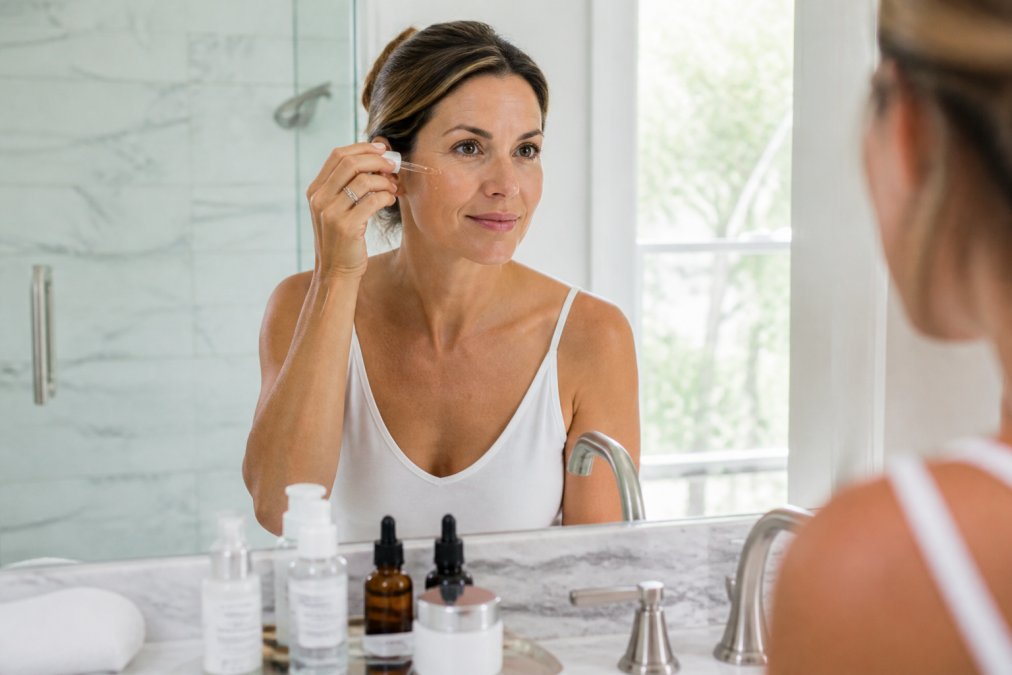
Morning: Cleanse, Treat, Protect
Start with a gentle cleanser. A 27% Glycolic Acid Facial Cleanser suits uneven skin and excess oil, while a foaming wash works better for compromised barriers. Follow with an antioxidant serum, then a 15% Niacinamide Gel Serum if pores and texture are your focus. Niacinamide also supports collagen production and helps balance oil.
Evening: Repair and Renew
Evening is where the real work happens. Cleanse thoroughly to remove sunscreen and debris. Apply eye cream next, since the eye area needs a lighter texture. Then apply your retinol treatment to dry skin.
| Step | Product Type | Frequency | Purpose |
|---|---|---|---|
| Cleanse | Gentle or glycolic cleanser | Twice daily | Remove debris, prep skin |
| Treat (AM) | Antioxidant, niacinamide | Daily | Defend, balance oil |
| Treat (PM) | Retinol | 2-3 nights, building up | Renew, smooth texture |
| Protect | Broad-spectrum SPF | Every morning | Prevent photoaging |
| Repair | Moisturizer, eye cream | Twice daily | Hydrate, support barrier |
How to Transition to Medical-Grade Skincare From Drugstore Products
Transitioning to medical-grade skincare works best as a phased swap, not a full replacement. Most people who fail at this step do too much at once and blame the products.
Budget-Conscious Professional-Grade Layering
You do not need ten products to build an effective routine. A daily regimen of four well-chosen items outperforms eight mediocre ones, and it costs less. Most guides assume an unlimited budget and recommend a full protocol from day one. That is not how value works in professional-grade skincare, the cost is front-loaded into a few high-impact actives, and the rest of the routine is support.
The Nighttime Anti-Aging Protocol →
The Four-Product Core
Prioritize in this order:
- Broad-spectrum sunscreen, the single highest-return step. Every morning, no exceptions.
- A retinoid, the workhorse for texture, fine lines, and cell turnover. One bottle lasts months at two to three nights per week.
- A gentle cleanser, removes sunscreen and debris without stripping the barrier.
- A moisturizer, supports the barrier so the actives above can do their job.
Those four cover preventative care, renewal, and barrier support. Everything else is optional until the core is consistent for at least eight weeks.
Where the Money Actually Goes
Professional-grade pricing is not uniform. The cost concentrates in the treatment step, not the cleanser or moisturizer. A gentle cleanser and a basic moisturizer do not need to be expensive to work well.
Build Order Over Time
A realistic sequence for someone upgrading on a budget:
- Month 1: sunscreen and gentle cleanser. Get consistent.
- Month 2: add a moisturizer. Confirm the barrier is stable.
- Month 3: introduce the retinoid at two nights per week.
- Month 4-6: add one targeted treatment, a peel, a niacinamide serum, or an antioxidant, only if a specific concern remains.
Adding one product at a time lets you judge whether it earns its place. If you cannot name the concern a product is solving, it is not a value purchase, it is a cost.
Value Traps to Avoid
- Buying a full protocol before your skin tolerates one active. The most expensive routine is the one you cannot use.
- Repurchasing sample sizes. Full-size is almost always cheaper per ounce, and it reduces packaging waste.
- Stacking two products that do the same job. Two exfoliating acids or two retinoids is not twice the result, it is twice the irritation and twice the spend.
- Chasing limited-edition packaging. The formula is what works, not the bottle.
Sustainability as a Cost Strategy
Sustainability matters here too. Choosing cruelty-free, non-toxic formulas and buying full-size rather than constantly repurchasing sample sizes reduces both waste and long-term cost. Fewer, better-chosen products mean less packaging, less shipping, and less money spent on items that sit unused. The budget-conscious routine and the low-waste routine are, in practice, the same routine.
Conclusion
The hardest part of a professional-grade routine is not finding products. It is building one you will actually follow for six months, and knowing which actives can safely sit next to each other.
Frequently Asked Questions
What is the difference between medical-grade and drugstore skincare?
Medical-grade skincare uses higher concentrations of active ingredients like retinol, niacinamide, and glycolic acid that are clinically validated to change skin at a cellular level. Drugstore products often contain these same ingredients at lower potencies because they are formulated for mass distribution and general safety. Professional-grade formulas also use delivery systems that improve absorption and reduce irritation, which is why a 4.5% retinol treatment can work without the redness users often get from weaker over-the-counter versions.
How long does it take to see results from a professional grade skincare routine?
Most people notice improved hydration and skin texture within two to four weeks. Fine lines and wrinkles respond more slowly because collagen remodeling takes time; expect eight to twelve weeks of consistent use before seeing meaningful change in line depth. Retinol-based routines often require a four to six week adjustment period where you build tolerance by starting two to three nights per week. Photographic documentation every two weeks helps track subtle progress that daily mirror checks miss.
Can I mix professional-grade brands in one routine?
You can, but layering products from different lines increases the risk of ingredient conflicts. For example, combining a high-percentage glycolic acid cleanser with a prescription-strength retinoid in the same routine can overwhelm the skin barrier. The safest approach is to use one core protocol built to work together, then add single targeted products one at a time. Wait two weeks between additions so you can identify what causes irritation if it appears.
Are professional-grade skincare products worth the investment?
Professional-grade products cost more because they contain higher concentrations of clinically studied ingredients and use delivery systems that improve how well those ingredients absorb. A $120 retinol treatment with a time-released delivery system may produce visible results in eight weeks, while a $30 drugstore retinol may take six months or never reach the same concentration. The key is consistency: one professional-grade product used nightly outperforms five drugstore products used sporadically.
How do I know if my skin barrier is damaged from active ingredients?
Signs of a compromised skin barrier include persistent redness, stinging when applying products that previously felt fine, flaking without improvement, and increased sensitivity to temperature changes. If you notice these, pause all exfoliating acids and retinoids for five to seven days. Use only a gentle cleanser and a barrier-repair moisturizer during that time. When skin feels calm again, reintroduce one active at a time at half the previous frequency.

Comments (0)
Back to Beauty